Sustainability & LEED Credits by Resysta Building Products
100% Recyclable, Wood-Free Rice Husk Composite Supporting LEED® v4 and LEED® v3 Green Building Certification Points
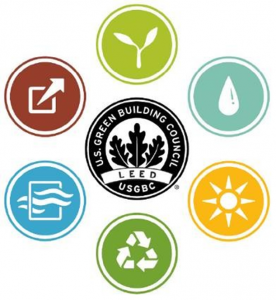
Resysta qualifies points for LEED® Green Building™ certificates when following all USGBC requirements
Resysta® material is 100% recyclable. Material waste may always be reused 100% and recycled into new material without degradation in quality. Resysta is 100% free of natural wood, zero wood waste involved in production, and is zero-toxic. It is a synthetic polymer made from rice husks, common salt, and mineral oils. Resysta requires minimal maintenance and is resistant to weather and insects.
Resysta products are extremely weather-resistant, durable, and require minimal maintenance. They do not rot, warp, or crack like wood, avoiding frequent replacements and chemical treatments.
Through material innovation and conscious design, Resysta supports sustainable building practices and contributes to earning valuable points under various Leadership in Energy and Environmental Design (LEED®) credit categories.
Three Pillars of Resysta Sustainability
Sustainable Sites
The Sustainable Sites (SS) category rewards decisions about the environment surrounding the building, site selection, and preservation. For Resysta application among buildings, ecosystems, and ecosystem services, it focuses on restoring project site elements, integrating the site with local and regional ecosystems, and preserving the biodiversity that natural systems rely on.
Materials and Resources
The Materials and Resources (MR) credit category focuses on minimizing the embodied energy and other impacts associated with the extraction, processing, transport, maintenance, and disposal of building materials. The requirements are designed to support a life cycle approach that improves performance and promotes resource efficiency. Each requirement identifies a specific action that fits into the larger context of a life cycle approach to embodied impact reduction.

Innovation in Design
Innovation (IN) - Sustainable design strategies and measures are constantly evolving and improving. New technologies are continually introduced to the marketplace, and up-to-date scientific research influences building design strategies. The purpose of this LEED category is to recognize projects for innovative building features and sustainable building practices and strategies.
LEED v4
Heat Island Reduction: 1-2 points
Resysta cladding / decking can be used as a solar heat island mitigation strategy for building envelopes. Solar Reflectance Index (SRI) values of certain colors of Resysta meet LEED v4 criteria.
Building Product Disclosure & Optimization - Material Ingredients (1 point)
Resysta products have a complete, published Health Product Declaration (HPD) with full disclosure of material ingredients, available on our website.
ID Credit 1: Rapidly Renewable Materials 5A6 - 1 point
Resysta products are made from 60% rice husks, an agricultural byproduct/waste of rice processing which functions as a rapidly renewable material.
LEED v3 (LEED v2009)
SS Credit 7.1: Heat Island Effect / Nonroof - 1 point
Resysta decking can qualify as a solar heat island mitigation strategy for building envelopes. Solar Reflectance Index (SRI) values of certain colors of Resysta meet LEED v3 criteria.
MR Credit 6: Rapidly Renewable Materials - 1 point
Resysta products are made from 60% rice husks. Rice husks are a byproduct of food plants, making it a rapidly renewable agricultural waste.
MR Credit 6.1: Material Disclosure and Assessment (1 point)
Resysta products have material disclosure documentation available through HPD collaborative.
LEED by USGBC org
LEED is a rating system developed by the United States Green Building Council to measure the environmental impact of building designs, construction, and operations.
LEED certification measures 94 points and is based on how much a building reduces operating costs and overall impacts on the environment.
LEED credit ratings have been used by the United States Green Building Council to measure the environmental impact of building designs, construction and operations. LEED certification is awarded in 4 tiers, and it behavior how your building projects commit to zero environmental impact on the environment.
LEED Rating Design & Rating Tiers for Building Projects Scale:
- Certified: 40-49 points
- Silver: 50-59 points
- Gold: 60-79 points
- Platinum: 80 points and over
Beginning on November 1, 2016, the United States Green Building Council (USGBC) LEED v4 replaced LEED 2009. The certification registration deadline for projects under LEED v2009 was June 30, 2021. Final Registration deadline for LEED v2009 project submissions was October 31, 2016.