
Can You Put Siding Over Brick?

Key Takeaways
- Siding can be installed over brick, but the existing masonry should be inspected first to make sure it is sound and suitable for the project.
- Furring strips may be needed to create a level and secure surface for attaching the new siding.
- Moisture management is essential, including proper flashing, drainage, and weather-resistive materials.
- The siding material matters. Vinyl, fiber cement, wood, and engineered wood have different installation and fastening requirements.
- Windows, doors, trim, and rooflines need careful planning because the new siding adds thickness to the exterior.
- Removing the brick is not always necessary. If the masonry is in good condition, keeping it and installing a properly designed siding system over it can be a practical option.
Table Of Contents
- Can You Put Siding Directly Over Brick?
- Why Would You Put Siding Over Brick?
- Change the appearance
- Update an older exterior
- Avoid removing all the brick
- What Should Be Checked Before Installing Siding Over Brick?
- Check the condition of the brick
- Look for moisture problems
- Check whether the wall is flat
- What Are Furring Strips?
- Can You Install Vinyl Siding Over Brick?
- Can You Install Fiber Cement Siding Over Brick?
- Can You Put Wood Siding Over Brick?
- What About Engineered Wood Siding?
- Do You Need House Wrap Over Brick?
- What Happens Around Windows and Doors?
- Does Siding Over Brick Make the House Look Bigger?
- Can You Cover Only Part of the Brick?
- Is It Better to Remove Brick Before Installing Siding?
- What Are the Benefits of Installing Siding Over Brick?
- Less demolition
- New design options
- Opportunity for insulation improvements
- Retaining existing masonry
- What Are the Potential Problems?
- How Is Siding Installed Over Brick?
- 1. Inspect the brick
- 2. Plan the wall assembly
- 3. Install flashing and moisture-management components
- 4. Install furring or another approved support system
- 5. Install siding
- 6. Finish windows, doors, corners, and transitions
- Should You Hire a Professional?
- Conclusion
If you have an older brick house and want to change its exterior, you may wonder if you can simply install siding over the existing brick. The short answer is yes, siding can sometimes be installed over brick, but it is not as simple as attaching siding directly to the brick surface.
The condition of the brick, the type of siding, the wall construction, moisture management, fastening method, and local building requirements all matter. In many cases, installers need to create a suitable attachment surface using furring strips or another approved system before the siding is installed.
This approach can allow homeowners to change the appearance of a brick exterior without completely removing the masonry. However, the existing wall needs to be evaluated before the project begins.
Can You Put Siding Directly Over Brick?
In some applications, siding can be installed over masonry, but the siding manufacturer's installation requirements determine whether direct attachment is permitted.
For example, the Vinyl Siding Institute's installation guidance recognizes masonry as one possible fastening substrate for some vinyl siding applications. However, the installation still needs to meet requirements for fastening, wall preparation, moisture management, and the specific siding product.
For many projects, installers use furring strips to create a more suitable and level surface for the siding.
Furring strips are narrow pieces of wood or another approved material attached to the existing wall. They provide a surface to which siding can be fastened and can help correct an uneven masonry surface.
The important point is that "siding over brick" does not necessarily mean placing siding directly against the brick and fastening it wherever possible.
Why Would You Put Siding Over Brick?
There are several reasons a homeowner might consider this approach.
Change the appearance
Brick provides a traditional appearance, but not everyone wants to keep the same exterior style. Siding provides a much wider range of colors, textures, profiles, and design options.
Fiber cement, vinyl, engineered wood, and other siding products can create very different looks.
Update an older exterior
Some older brick homes have exterior designs that no longer match the homeowner's preferences. Adding siding to selected areas can give the house a more updated appearance.
It is also possible to combine brick and siding rather than covering the entire exterior. Designers and manufacturers commonly show combinations where brick remains on part of the home while siding is used on upper sections, gables, or additions.
Avoid removing all the brick
Removing a brick exterior can involve significant labor, debris, and additional work. If the existing masonry is sound and the proposed siding system can be properly installed over it, keeping the brick may be an option.
However, avoiding brick removal should not come at the expense of proper moisture management or structural work.
What Should Be Checked Before Installing Siding Over Brick?
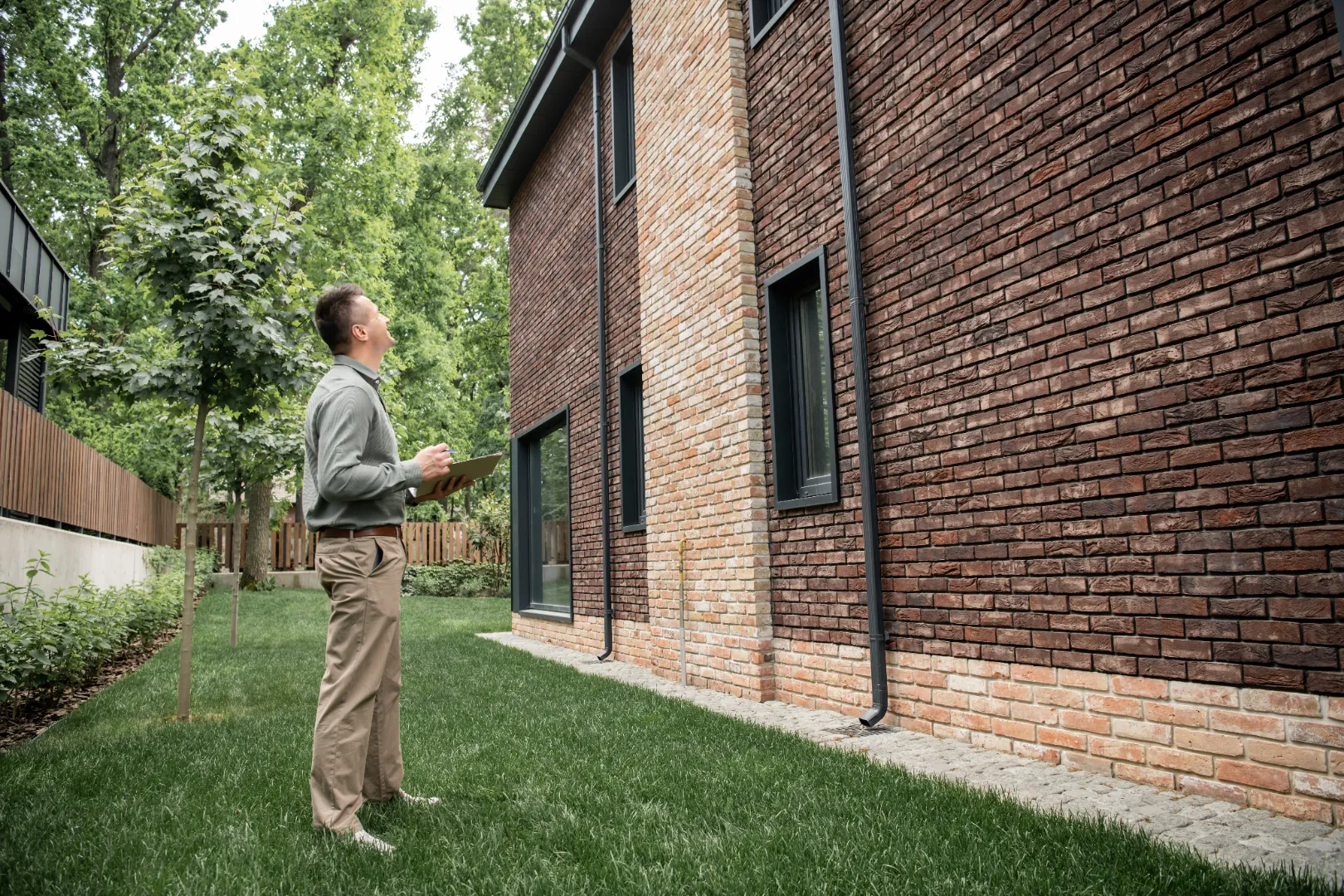
The first step is to inspect the existing brick and the wall behind it.
Check the condition of the brick
Loose, cracked, badly deteriorated, or unstable masonry should not simply be covered.
An installer needs to determine whether the brick can safely remain in place and support the proposed installation system.
If there are major cracks, loose sections, water damage, or other structural concerns, those issues should be addressed first.
Look for moisture problems
Moisture is one of the most important issues to consider.
Brick can be exposed to rain and moisture, and the wall assembly needs to be designed so water does not become trapped where it can damage the building.
Modern siding systems are not intended to act as a substitute for proper water-resistive barriers and flashing. The Vinyl Siding Institute describes vinyl siding as an exterior cladding rather than a water-resistive barrier.
This means the installation needs to account for the wall's water management system rather than assuming the siding itself will keep all moisture out.
Check whether the wall is flat
Brick surfaces are rarely as flat as a purpose-built siding substrate.
Uneven areas can make siding difficult to install correctly and can result in a wavy or uneven finished appearance.
The Vinyl Siding Institute recommends checking walls for evenness and using furring strips where necessary to establish a smooth and continuous surface.
What Are Furring Strips?
Furring strips are an important part of many siding-over-masonry projects.
They create a fastening surface in front of the existing brick. The strips can be arranged to provide the necessary support and help create a more consistent plane for the siding.
The exact material, spacing, fastening method, and dimensions depend on the siding product and the building.
For example, the fasteners for vinyl siding need to have adequate holding power. The Vinyl Siding Institute notes that siding may be fastened to wood studs, furring strips, or directly to masonry when permitted by the installation requirements.
This is why the installer should not simply choose a few screws and attach the siding to the brick.
The fastening system needs to be designed for the specific siding and wall.
Can You Install Vinyl Siding Over Brick?
Vinyl siding can be used in some applications over masonry, provided the installation meets the manufacturer's requirements.
The Vinyl Siding Institute's installation manual specifically discusses re-siding and the use of furring strips to establish a smooth surface where needed. It also emphasizes proper flashing, water-resistive barriers, and appropriate fastening.
One benefit of vinyl siding is that it is relatively lightweight compared with some other exterior cladding materials.
However, the fact that vinyl is lightweight does not mean it can be installed over any brick wall without preparation.
The wall still needs to provide a suitable fastening system, and the siding needs to be installed according to the manufacturer's instructions.
Can You Install Fiber Cement Siding Over Brick?
Fiber cement siding can also be used in projects where brick remains part of the exterior, but installation details are product-specific.
Fiber cement is heavier and more rigid than vinyl siding, so the fastening and support requirements need careful attention.
Manufacturers provide detailed installation requirements for their products, including fastener specifications, clearances, flashing, and moisture management.
For example, James Hardie's installation guidance emphasizes proper weather barriers, flashing, clearances, and approved fastening methods for its siding products.
A contractor should therefore determine exactly how the selected fiber cement product is approved to be installed over the existing wall before work begins.
Can You Put Wood Siding Over Brick?
Wood siding can sometimes be installed over masonry using an appropriate framing or furring system.
Wood siding requires a properly prepared and adequately supported surface. The wall also needs appropriate protection from moisture.
Because wood is susceptible to moisture-related problems if it is installed incorrectly, drainage, ventilation, flashing, and clearances should be considered carefully.
The exact installation method depends on the siding profile and the existing wall construction.
What About Engineered Wood Siding?
Engineered wood siding can also be considered for a brick-over-cladding project, but the same principle applies.
The existing brick needs to provide an acceptable base for the selected attachment system, or a new fastening surface may need to be constructed.
Always check the product's installation instructions before deciding how it will be attached.
Do You Need House Wrap Over Brick?
This is one area where there is no universal answer.
The correct wall assembly depends on the existing construction, the type of brick, whether the brick is structural masonry or veneer, the siding product, local building requirements, and the manufacturer's installation instructions.
A water-resistive barrier may be required as part of the overall wall assembly. Some siding manufacturers specifically require or recommend weather barriers and flashing as part of their installation systems.
James Hardie, for example, describes its weather barrier products as part of a moisture-management approach designed to help keep the wall assembly drier.
A contractor should determine how the existing brick wall and proposed siding system are supposed to work together instead of adding a layer simply because it is commonly used on other types of walls.
What Happens Around Windows and Doors?
Windows and doors require special attention when siding is installed over an existing brick exterior.
Adding siding and furring strips increases the thickness of the exterior wall surface. That can change the relationship between the siding, window frames, doors, trim, and flashing.
If these areas are not detailed correctly, water can enter around openings.
Flashing is particularly important at transitions and penetrations. James Hardie's installation guidance includes specific recommendations for flashing around wall intersections, rooflines, and other areas where water needs to be directed away from the wall assembly.
This is one reason a siding-over-brick project should be planned as a complete exterior system rather than treating it as simply a cosmetic covering.
Does Siding Over Brick Make the House Look Bigger?
It can change the visual proportions of a house.
Adding furring strips and siding increases the exterior wall depth, but the visual effect depends on the design.
Trim around windows and doors may need to be extended or redesigned. Corners may require additional trim. Roof and wall transitions also need to be considered.
Good planning can make the new siding look intentional rather than appearing to have been placed on top of an existing wall.
Can You Cover Only Part of the Brick?
Yes, in many designs, brick and siding can be used together.
For example, you might keep brick on the lower portion of the exterior and use siding above it. Another option is to keep brick on the front of the home while using siding on the sides or rear.
Siding can also be used on gables, dormers, additions, and other sections.
This approach can preserve some of the character of an existing brick exterior while introducing a different material.
Combining brick and siding is also a common exterior design strategy. James Hardie, for example, provides design examples showing brick paired with fiber cement siding in different parts of a home's exterior.
Is It Better to Remove Brick Before Installing Siding?
Not always.
Removing the brick may make sense if the masonry is badly damaged, unstable, creating moisture problems, or preventing the desired siding system from being installed correctly.
On the other hand, if the existing wall is sound and the proposed siding can be properly supported over it, keeping the brick may be practical.
The decision should be based on the condition of the existing wall and the requirements of the new siding system, not simply on the desire to save demolition costs.
What Are the Benefits of Installing Siding Over Brick?

There can be several benefits when the installation is appropriate.
Less demolition
Keeping sound brick can reduce the amount of demolition required compared with completely removing the masonry.
New design options
Siding comes in many colors, textures, and profiles, giving homeowners more exterior design choices.
Opportunity for insulation improvements
Depending on the wall assembly and project design, a re-cladding project may provide an opportunity to improve the home's thermal performance.
The exact insulation options depend on the existing construction and local requirements.
Retaining existing masonry
If the brick is in good condition, keeping it can preserve the existing wall while changing the exterior appearance.
What Are the Potential Problems?
Installing siding over brick is not automatically the right choice.
Potential problems can include:
- Improper fastening
- Trapped moisture
- Uneven siding
- Poor flashing details
- Problems around windows and doors
- Increased wall thickness
- Inadequate clearance from the ground
- Failure to address damaged masonry
- Installation that does not meet manufacturer requirements
These problems can often be avoided through proper planning and installation.
For example, James Hardie's installation guidance specifies minimum clearances at areas such as the ground, rooflines, decks, and other transitions.
How Is Siding Installed Over Brick?
The exact process depends on the siding and wall, but a project may generally involve these stages:
1. Inspect the brick
The contractor checks the masonry for cracks, loose sections, moisture problems, and other issues.
2. Plan the wall assembly
The installer determines how the siding will be supported and how water will move through and away from the wall.
3. Install flashing and moisture-management components
Required flashing and weather-resistive materials are installed according to the project's design and product requirements.
4. Install furring or another approved support system
Where required, furring strips create a suitable plane for the siding.
5. Install siding
The siding is attached using the manufacturer's specified fasteners, spacing, clearances, and installation method.
6. Finish windows, doors, corners, and transitions
Trim and flashing are installed around openings and transitions to provide a finished appearance and manage water.
The actual installation sequence can vary significantly by siding type.
Should You Hire a Professional?
For a siding-over-brick project, professional installation is generally the safer approach.
The project involves more than attaching siding. The installer needs to understand the existing wall, fastening requirements, moisture management, flashing, clearances, and the siding manufacturer's instructions.
James Hardie, for example, recommends that full fiber cement siding projects be undertaken by siding professionals familiar with the material and proper installation methods.
A qualified contractor can also identify problems with the brick before they become hidden behind the new siding.
Conclusion
So, can you put siding over brick?
Yes, it can be possible, but the answer depends on the condition of the brick, the type of siding, the existing wall construction, and the installation system being used.
In many cases, siding is installed over a prepared surface rather than simply being attached directly to the brick. Furring strips may be used to create a level fastening surface, while proper flashing and moisture-management components help protect the wall assembly.
Before starting the project, inspect the brick, identify any moisture problems, check the manufacturer's installation requirements, and consider how the additional wall thickness will affect windows, doors, trim, rooflines, and other exterior details.
If the brick is sound and the siding system is designed for the application, covering the brick can be a practical way to change the home's exterior without removing all of the existing masonry. If the brick has significant structural or moisture problems, however, those issues should be addressed before the new siding goes up.
The goal is not simply to put a new material over an old one. A successful siding-over-brick project creates a properly supported, weather-managed exterior wall that looks good and performs as intended for years to come.